Sunday, February 12, 2006

OPINION
DURIAN
text AMINA RASUL, Former Presidential Adviser on Youth Affairs

Making democracy work in Muslim communities

GLOBALIZATION, modernity and the increasing secularization of our communities have brought tensions that have moved Muslims to strengthen their faith in defense of the entry of “un-Islamic influences.” Tensions have recently found release in the outrage over the extremely offensive Danish cartoons depicting the Prophet Muhammad (Peace be upon Him). Unfortunately, violence has accompanied the outrage. Many have been hurt and property damages are estimated in the millions of dollars.
The European media, in self-righteous indignation, justify their offense by crying “freedom of expression.” Surely they must have anticipated the resultant fury. We recognize the importance of free speech. What about media’s responsibility and accountability to the community, beyond increasing sales? Especially today when suspicions between the West and the Muslim world run high and the need for mutual understanding is great. It is discouraging that while some tirelessly advocate mutual respect and compassion, others willfully stir up hostilities.
Early this week, Islamic scholars and Muftis (most learned ulamas who can interpret sharia and give fatwas, or religious edicts) gathered for a 3-day forum on peace and democracy organized by the Philippine Council for Islam and Democracy (PCID). They condemned the vilification of the Prophet but at the same time called for restraint. Their statement reads: “We caution the ummah [the Muslim community] in the Philippines against the use of violence as a way of protesting this insult to our faith. The teaching of sharia condemns all forms of unjust and unreasonable use of violence, for Islam is the religion of peace and the Prophet [PBUH] condemns all such forms of violence especially those done in His name.”
Muslim faithful in Cotabato City and Manila have protested the insult in nonviolent demonstrations. Most Muslims live in communities very different—many would say “closed”—from that of the West. Will Muslims jump with alacrity out of their set ways to embrace the freedoms of the Western countries? As my teenage son would say, with all the incredulity he could muster, “Duh! [Translation: you must be kidding].”
Muslims have to learn to live in this rapidly globalizing, continuously modernizing world. Dr. Surin Pitsuwan, member of the Thai Parliament and former Thai foreign minister, spoke of the need for Muslims to adapt, adopt and innovate as the forces of globalization enter our neighborhood.
Dr. Pitsuwan, a force for progressive thought and democracy, has been the keynote speaker of two PCID regional forums. He also warned against the Western belief that Muslims will jump at the chance to don the garb of the modern West in pursuit of democracy. Democracy must be home­grown. Dr. Pitsuwan believes that “majority Muslims are inventing, restructuring, redesigning the system in order that the state system would become vehicles for the promotion of the values, of the identities, and the interests of the larger ummah.” Hence, Muslims ought to “come up with effective systems and frameworks that would be enabling to the mainstream Muslim majority in order to maintain, promote and protect their own way of life and their own interests.”
How do we participate in the democratic framework, without compromising our values and identity as Muslims? (Some ask whether democratization means being less Islamic or whether being Islamic means less democracy.) Democratization, in all of its facets—participation, justice, liberty, equity—still remains the key to neutralizing violent radical movements, whether Muslim or Christian.
We must recognize that the Muslim communities around the world and in the Philippines have distinct cultural and environmental contexts. Thus, we face the challenge of building social, political, economic institutions within our communities that would allow for multiple views: between different Muslim groups and from people of different religions. As such, the dynamics of democratization will inevitably vary from one Islamic community to another. More importantly, the challenge of creating social, political and economic institutions that are just need to be addressed, if we are to find relevant solutions to the estrangement of Muslims and the resultant radicalization.
Danish cartoons do not help. Danish pastries, maybe.
EHEM!
Corruption in the Philippines is very serious.
Be sensitive! Be bothered! Be involved! Ehem!

The "FIERY" Cartoon Row

We are witnesses to the "fire" that continues to burn, because of the publications of the Cartoons on the Prophet Muhammad...For many people, especailly in the West, the frenetic and fiery responses coming from the Islamic communities seemed incomprehensible...I am re-printing a short commentary of Karen Armstrong - a well known woman author on Islam. Her two famous books are Muhammad: A Biography of the Prophet and The Battle for God: A history of Fundamentalism... Both books are very good reading to begin to understand the complex movements in the world of Islam. Jun Mercado, OMI
Karen Armstrong says... Each side needs to appreciate the other's point of view. I think it was criminally irresponsible to publish these cartoons. They have been an absolute gift to the extremists - it shows that the West is incurably Islamophobic. It sends a very bad message.
But, more seriously, it is letting ourselves down. We trumpet abroad about what a compassionate culture we are. But these cartoons depicting Muhammad as a terrorist are utterly inaccurate, feeding into an Islamophobia that has been a noxious element in Western culture since the time of the Crusades. It can only inflame matters at this very crucial juncture of our mutual history.
On the other hand, in a secular Europe, freedom of speech has developed as one of our sacred values. We fought hard for it, but we have to remember it carries responsibilities. For example, do we have a right to say whatever we want even if it is false and dangerous?
More importantly, however, freedom is as sacred a value for us as the Prophet is to Muslims. We are seeing here a clash of two different notions of what is sacred and this is part of the modernising process. Modernisation and secularisation has this bumpy ride where people at different levels of modernisation are clashing. In other parts of the world where modernisation is not yet complete it is not regarded as a crucial as other sacred realities.
And now we are all living in this multicultural society cheek-by- jowl with one another, not even within a single country but we are linked to one another in our global village. We have to learn to live side by side better than this.(EHEMgroups)

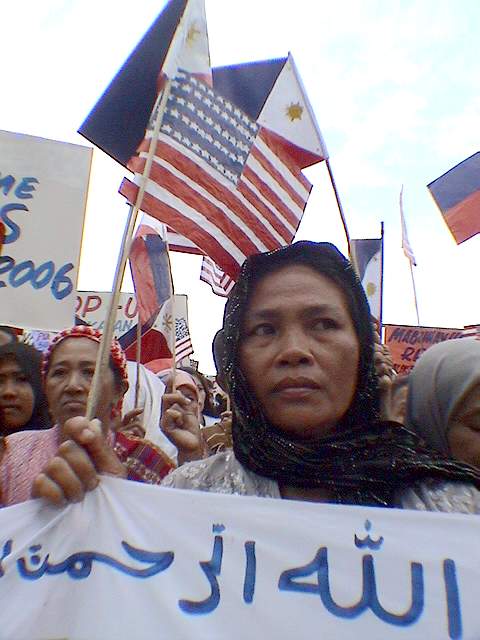
Muslim Tausug women
attending a pro-Balikatan
rally in Jolo, Sulu. (HADER GLANG)

Facts concerning U.S. service
members visiting the Philippines

RECENT reports in the Philippine media have raised issues regarding rules of behavior for members of the U.S. Armed Forces traveling to the Philippines to participate in the joint military exercise "Balikatan 06."
All U.S. military personnel participating in joint U.S.-Philippines military exercises and activities in the Philippines are made fully aware of Philippine culture and sensitivities and their obligation to obey Philippine law.
Orders to visiting U.S. military personnel regarding sexual conduct and prostitution are unequivocal: soliciting a prostitute is a crime and a violation of the Uniform Code of Military Justice, the foundation of military law in the United States. Solicitation of prostitutes by any U.S. military personnel visiting the Philippines is strictly prohibited.
No liberty or annual leave is authorized to U.S. Armed Forces personnel participating in “Balikatan 06.”
General Order Number 1 for all U.S. military personnel participating in "Balikatan 06" joint exercise states, "Each participating American citizen is an informal ambassador in the Philippines, representing the United States. U.S. personnel will treat others with appropriate military courtesy whether on or off duty, in or out of uniform. U.S. personnel will be considerate of Philippine customs and will not engage in any behavior, wear any clothing or make any statement which may offend a Filipino."
Mutual respect and shared commitment to the protection of the national interests of our two nations is the foundation for the long-lived, excellent cooperation between Philippine and U.S. military and security forces.
During "Balikatan '06" and all such exercises, the U.S. will continue to assure that its service members obey Philippine law and respect Philippine dignity and sensitivities. (PRESS RELEASE)

Saturday, February 11, 2006

IMAGE OF THE DAY

Followers of Sultan Sharif Pulalun of Sulu and North Borneo stage a pro-Balikatan (shoulder to shoulder) rally in downtown Jolo on Saturday. About 250 US soldiers and a thousand Filipino troops are participating in the joint military exercises set to start next week. (HADER GLANG)
Sultan Pulalun’s pro-Balikatan
rally in Jolo draws a thousand
text HADER GLANG

Some 1,000 Muslims have gathered in the capital town of Jolo to support the joint US-Philippines anti-terrorism exercise, which will formally kick off on February 20 simultaneously in the islands of Sulu, Cebu and Luzon.
The gathering, led by the influential Sultan of Sulu and North Borneo, Sharif Ibrahim Ajibul Mohammad Pulalun, urged for full support to the holding of Balikatan Exercise 2006 in the troubled island province.
The demonstrators carried banners with “Welcome America” markings. “Welcome and Mabuhay!!!RP-US Balikatan 2006…the answer to peace, progress and development in Sulu!!!” a large banner said. “Balikatan give more humanitarian support to Sulu and the people,” another said.
They marched from a youth center in Jolo to the in frontage of the town’s police station, where they held a brief rally. Many marchers, particularly the women, were clad with traditional Tausug attire and carried Philippines and American flaglets.
Sultan Pulalun at the scene declared his full support to the Balikatan as he appealed to every Muslim in the province, young and old to welcome their American visitors and support the joint military exercises.
“Let us show to the world that we are peaceful citizens. We ask for nothing in return, but I humbly appeal to them to help our poor people and give them access to basic services on proper education and health services,” he said.
Lt. Col. James McAllister, head of the Joint Task Force-Philippines based in Sulu, thanked Sultan Pulalun’s warm welcome for US troops. “It is an honor and we are very glad that the people of Sulu are supporting the annual bilateral exercise.”
But the US’ humanitarian mission and civic activities in Sulu have come under fire by the Suara Bangsamoro group and its allies since the spate of killings early this month that happened in the villages of Patikul and Jolo towns.
The Suara Bangsamoro, which has been vocal against the presence of US forces and staged an anti-Balikatan last week, said the coming of US forces in Jolo only created more conflict in the island province, where killings happened almost everyday.
Sulu is a known stronghold of the extremist Abu Sayyaf. Just Friday, the group beheaded a man and gunned down a police agent, reportedly one of the security escorts of a foreign journalist covering the Balikatan exercise, in downtown Jolo.
Authorities tagged the brother Anni and Itting Sailani as behind the killings. The two were also implicated in the killing of a Filipino photojournalist Gene Boyd Lumawag in Jolo island in November 2004.
US military forces were credited with helping Filipino troops decimating the Abu Sayyaf group that had bombed several areas in the southern Philippines, killing scores of people and wounding hundreds. – (ZS)

Thursday, February 09, 2006

Sulu Sultan to lead pro-Balikatan rally

Sulu and North Borneo Sultan Sharif Pulalun


THE influential Sultan of Sulu and North Borneo, Sharif Ibrahim Ajibul Mohammad Pulalun, will lead a rally on Saturday in Jolo town to prove to the world that his province supports the RP-US joint military exercises, which will formally start on February 20 simultaneously on the islands of Sulu, Luzon, and Cebu.

In a press statement, the Sultan announced that he would hold a rally in the capital town of Sulu together with his followers and several groups who welcome the joint anti-terrorism military exercises in the province.
“We call on our people to support the Balikatan humanitarian project in our province. Let us welcome our American visitors with open arms,” Sultan Pulalon said.
Contrary to what other people in Sulu have claimed that Balikatan would only worsen the critical situation in the province, the Sultan believes the joint exercise would do good than harm.
He continued to praise the coming of the US troops in Sulu. “There is nothing wrong with the presence of Americans in our province because they are here to help poor families, especially those who have no access to basic services such as health and education.
This year’s Balikatan exercise will be structured to further develop the Armed Forces of the Philippines (AFP) in crisis action planning, enhancing its ability to effectively conduct counter terrorism operations, and promote interoperability between two participating countries.
It will provide humanitarian and civic assistance, which will improve RP-US military civic action cooperation, and train civil-military personnel to work together with a focus on civic assistance.
Approximately 250 US personnel will participate in the joint multiple medical, dental, veterinary and engineering civic action projects as part of “Project Bayanihan.”
But the Suara Bangsamoro Partylist and the Union of Muslims for Morality & Truth insisted that US forces used humanitarian missions as an alibi to rationalize their presence in the province.
“Their presence might provoke more tension in a province already wracked by violence and poverty,” Cocoy Tulawie, councilor of Jolo town and vice president of the group Suara Bangsamoro, said in a press statement.
“The Moro people have been witnesses to the direct and active participation of US soldiers in last year’s military offensives in their communities, despite the US official’s assurances that they were merely doing socio-civic actions in the communities.”
“It is ironic that it is the heavily armed US soldiers who will hand out the sewing machines and hospital equipment and construct infrastructures in our communities, knowing that these same people are the ones who trained to kill all those who looked like Bin Laden, their trained terrorist-turned-enemy.” (ZS)

Wednesday, February 08, 2006

PGMA allots P500m for roads; P100m for Zambo


President Arroyo leads the groundbreaking ceremonies
February 8 for the proposed historical marker at the
site where Dr. Jose Rizal disembarked from the boat
that brought him to exile in Dapitan, Zamboanga del
Norte on July 17, 1892. The landing site project has
a total cost of P15 million. With the President in photo
are (from left) Zamboanga del Norte Governor Rolando
Yebes, Rep. Cecilia Jalosjos Carreon, Vice Governor
Francis Olvis and other local officials. (OPS-NIB)

PRESIDENT Gloria Macapagal-Arroyo on Wednesday ordered the Department of Budget and Management (DBM) to release immediately P500 million for various road projects in the country, including P100 million or one-fifth of the entire amount, to fund the completion of the long delayed Zamboanga-Pagadian national road project.
The President issued the directive during her meeting with members of the various publications and radio stations at the Natalia Hall of the Camila Hotel here.
"I have instructed the DBM to release P500 million today for the completion and repair of major roads," the President told some 100 reporters and guests.
She pointed out that the new allocation and the other funds released early this year are part of her administration’s P35 billion outlay to pump prime the economy.
She added that funding for her pump priming projects was made possible because of the renewed investor confidence in the country, stability of the economy, good governance and tax reforms, particularly the Reformed Value Added Tax (R-VAT) Law.
The President also pointed out that the recent favorable investment rating of the country by the consultancy firm CalPERS (California Public Employees' Retirement System) was a contributing factor to the improved economy. (OPS)
GRP, MILF optimistic of progress in peace talks

PORT DICKSON -- Exploratory talks here between representatives of the Philippines government and the Moro Islamic Liberation Front (MILF) to end a 40-year armed conflict in the southern Philippine region of Mindanao ended on an optimistic note Tuesday.
At a news conference at the conclusion of two days of talks, Philippines government delegation leader Silvestre G. Afable said he expected the two-year-long peace talks "to be conclusive before the end of the year".
He said he was deeply satisfied not only with the ongoing talks but also the whole range of talks for the past two years arranged by the Malaysian government.
"We see growing popular support in Mindanao and international support" for the talks, he said.
He was also encouraged by the very strong commitment of Philippines President Gloria Macapagal-Arroyo and Malaysian Prime Minister Datuk Seri Abdullah Ahmad Badawi for the peace talks.
Afable said the Philippines government was committed to achieving a just peace in Mindanao and "very happy that MILF had responded with the seriousness and commitment and very good representation" and with all these factors they would reach their goal sooner than expected.
MILF delegation leader Mohagher Iqbal said their hope of achieving a just, comprehensive and durable peace in Mindanao was "getting nearer and nearer."
He said among the issues to be discussed was a political solution between both parties.
A joint statement issued at the end of the 10th round of talks by the two sides said four consensus points on the ancestral domain issues were reached.
It said the consensus points agreed upon included a joint determination of the scope of Bangsamoro homeland based on the technical maps and data submitted by both sides and measures to address the legitimate grievances of the Bangsamoro people arising from their unjust dispossession and marginalisation.
The other two points were Bangsamoro people's right to utilise and develop their ancestral domain and ancestral lands and economic cooperation arrangements for the benefit of the entire Bangsamoro people.
The two sides also agreed to conduct joint advocacy drives on the ancestral domain issues to broaden public understanding and support for the peace process.
"To achieve this objective, a joint committee was formed to draw up the guidelines, plan the advocacy campaign and seek the participation of non-government organisations, people organisations and civil society groups in advocacy activities," the statement said.
Both sides reaffirmed the need to intensify capacity building programmes with the assistance and support of the international community and donor institutions, and they agreed in principle to the establishment of a Bangsamoro Leadership and Management Institue in Cotabato City as a capacity building centre for emerging leaders and professionals.
Also present at the news conference was Datuk Othman Abdul Razak, the adviser of the Prime Minister in the peace talks. (MNNA)
IMAGE OF THE DAY

Beautiful enough to write sonnets about. The end of the day sets in a fiery kaleidoscope of colors over the Moro Gulf in Zamboanga City. (HADER GLANG)
Patal Elementary School: How
persistence changed a Tausug village

KARUNGDONG, Bongao, Tawi-tawi – The spotless, chalky bungalow-type building seems like an anomaly amid the rustic and grimy terrain. Its dirty-white paint appears whiter with all the russet colors of the earth, scanty huts and coconut trees surrounding it.
A single flagpole stands erect in front of the building, pinned to the ground by the scarlet concrete and the unbreakable resolve of the young children to sing the national anthem much louder than the others.
Assorted garden flowers enfold the building, daring to separate the structure from the hard earth but only managed to break the uniformity of shades by the bright colors of its blooming buds.
From the distance, the school building dominates the whole view, holding the sky, earth, and houses together like glue. Village elders here conceded that almost overnight, the school became the community’s plaza, where children converge to play and adults congregate to talk, and occasionally scold a naughty child or two.
This is Patal Elementary School, home to over 200 poor Tausug school children, sons and daughters of farmers, fishermen, carpenters and bums; where family incomes are not measured by how much but how often food is placed on the table-- bringing another dimension to the term “hand-to-mouth” existence.
The school’s development is a testimony to the Tausugs’ tenacity and persistence, especially to Siliperlma Jurakman -- one really stubborn volunteer teacher.
A modern Moses
Just five years ago, the circumstances here were very different. The primary school then stood on a small patch donated by one of Jurakman’s uncles, the under brushes stunted by the brutal sun.
It was just a crude structure of jagged timbers, cracked plywood, and torn nipa for its roof, measuring less than the average classroom. The walls were bare, exposing the children to all the elements, and so was the floor. There were no chairs, only dilapidated lumbers that served as benches.
The school’s design was understandable since it was constructed by the village’s own rudimentary hands. Jurakman rounded up the able-bodied men, for almost all of the 1,000 residents in this village are related by one degree or the other, and practically ordered them to build a school.
When the rains come, the whole class splits because of a big hole in the roof while Jurakman stood in the middle like the Biblical Moses parting the Red Sea.
“When the bare floors got muddy, the children raised their feet to avoid getting wet,” she recalls in Tausug.
Twelve-year old Silina Ipari, who was one of the pioneer students of the school, remembered the difficulties they endured then when attending classes.
“We write on our laps or on the backs of our classmates,” she said.
Ipari said their teacher had to give them scratch papers and torn textbooks for their notebooks for lack of money to buy for their own.
“But now, it’s easier to learn because we have chairs and blackboards,” she said. Ipira is a consistent honor student.
Standing a shade above 5 feet, Jurakman always has a ready smile. Out of shyness, her anxious hands subconsciously cover her mouth when she laughs.
Her healthy girth, long straight hair, and short stature give the appearance of carefree and indolent attitude, belying an immovable spirit that transformed the lives of her whole community.
Change is coming
In the early months of 2003, a representative from the Japan Grant Assistance for Grassroots Projects, along with the Philippine Business for Social Progress, conducted an ocular inspection of the area paving the way for the donation of one school building.
Several problems emerged: for one, the school then rested on a rocky terrain, which would make it difficult for the workers to dig the foundation; second, they have no site to transfer the school. They were sitting on donated land in the first place.
Jurakman mentioned their dilemma to her uncle, Salim Mutalib, who readily donated almost all of his land to the school.
He now lives in a parcel of land, about 500 meters away from the school, where he grows vegetables, corn, and raise livestock.
Speaking in a mixture of Visayan and Tausug, Mutalib explained that he never had the opportunity to finish elementary, as most of his contemporaries, because of the hard life.
“That’s why I donated this land so my grandchildren, grandnieces and nephews can go to school unlike us,” he said.
But the problem did not end there.Jurakman had to process the papers required by the organizers before the donation of the school. That means visiting government line agencies located in Bongao central, some 10 kilometers away.
Brgy. Karungdong is a small upland community, measuring about 1.7 square kilometers, mostly planted to cassava and coconut. It can be reached by motorcycle from Bongao poblacion in 30 minutes.
That means shelling out P40 daily for her transportation fare alone. By that time, her monthly allowance had ceased along with her contract with the local government unit for her teaching services.
“I go there and process the papers, most days I don’t eat lunch and walk all the way home,” she said.
To survive, she had to sell native rice cakes by daybreak then rush to the school to teach her grade 2 students afterwards. “Then I end the class early so I can go to Bongao to process the papers,” she said.
Bearing fruit
Her efforts were not wasted, however. In April of 2003, construction for a three-classroom school building began, owing to the P1,645,593.97 grant provided by the Japan Grant Assistance for Grassroots Projects.In September of that same year, the new school building was launched.
About 134 grade school pupils enrolled in grades 1, 2 and 3, all taught by one regular teacher supported by three volunteer teachers.
It came equipped with chairs, blackboards, chalks, desks, educational paraphernalia and textbooks.
A parallel program on livelihood for 50 members of the Parents-Teachers-Community Association (PTCA) was implemented last year, which is aimed at providing them additional skills for gainful employment.
The school also welcomed its new principal, Hamad Asmad, who was very familiar with Jurakman since she approached him several times for help while processing the required papers.
The changes in the community are palpable. Village elders and parents here consider the school as their own, even designating some to guard the school from vandals and the occasional wandering goats to maintain its cleanliness.
The village’s actions are not surprising because the Tausugs, despite their reputation as a fierce people, place a very high value on education, Asmad said. “The educated among us has a high place in the community.”
The school has also been harvesting awards in athletics, dominating the 100 and 500-meter dash, lambatan (sepak takraw), badminton, chess, and volleyball.
Asmad bared that the school ranks 4th in academics among the seven elementary schools in Bongao II District, including Pababag Elementary School; Tongsina Elementary School; Yusup Dais Elementary School; Mohasali Elementary School; Pag Asman Elementary School; Sanga-sanga Elementary School and Salip Angkaya Patal Elementary Group Schools.
Scholarships, too
All of the children here are PBSP scholars, which entitles them access to uniforms, raingears, and school supplies. Even with the new building and facilities, the poor situation of the community forces parents, whose family income range from P1,000 to P1,500 monthly, to put premium on food rather than education.
Textbook assistance was also provided to increase the textbook to pupil ratio to 1:3. In 2004, for example, teachers had only three textbooks to work with for the first three grade levels.
Lessons and exercises were usually written on the board while students crammed to copy them.
The principal credited Jurakman’s efforts for whatever success the school is reaping today. “She was really instrumental in the building of this school,” he said in English.
Ironically, for all her heroic efforts, Jurakman has yet to receive an item from the Department of Education in the Autonomous Region in Muslim Mindanao (ARMM), absorbing her into its roster of regular teachers.
“But at least now, I’m probationary and considered to be given an item,” the ever-smiling Jurakman, who is now the grade 6 adviser, said.
The teacher went back to her new classroom followed by a throng of her female students, or perhaps her nieces. One of them tugged at the edge of her slacks, her face constricted in enthusiasm. Jurakman hugged her.
Outside, children play their own version of a volleyball game, where one team has two extra men. Nobody seemed to notice, or nobody seemed to care.
A group of girls huddle in the corner, their delightful screams rising and ebbing to the trajectory of the ball. In the opposite corner are the elders animatedly conversing, their mean-looking scythes hanging by their sides as the staccato of foreign words melt in the air along with the thick cigar smoke. (PBSP)

Tuesday, February 07, 2006

ARMM governor orders tight security
in Lanao del Sur to avert political row

Autonomous Region in Muslim Mindanao Governor Zaldy Ampatuan has ordered the ARMM police force to employ a tightened security measures in Lanao del Sur to prevent any untoward incident that may happen as a result of the political squabbles among local officials in the province.

This, after 30 mayors of the 45 towns of Lanao del Sur filed recall election proceeding against Provincial Governor Aleem Bashir “Mustaqbal” Manalao, who took over the governorship by law of succession following the death of Governor Mamintal Adiong in 2004.

"We don't want any trouble to happen in the province because of this political conflict so we directed the police to make necessary measures to maintain law and order," Ampatuan said in a press statement.

He made clear that the leadership of the ARMM is taking a neutral position and not in any manner siding with any particular group in the Lanao del Sur recall election issue. “The move is purely an initiative of some political leaders and their supporters in the province who may not be happy with Governor Manalao.”

The petitioners have already gathered 30,000 signatures from the voters of the province and filed their complaints before the Commission on Elections against Manalao, who has just assumed his post after a 90-day preventive suspension order issued by the Office of the Ombudsman.

The mayors said they have already lost their trust and confidence to the leadership of Manalao.
"If the recall election will be materialized and the people of Lanao del Sur will choose their new leader in a legitimate and legal process, then we will respect their decision. The most important thing here is we don't side with anyone in this political squabbles," Ampatuan said. (BPI-ARMM)
IMAGE OF THE DAY

Dance for peace. To the beat of Latin music, exuberant dancers release a dove during street dance competition in Zamboanga City. (HADER GLANG)

Monday, February 06, 2006

Sex workers flock to Jolo for US troops

LURED by the prospects of earning more from American soldiers participating in the joint Philippine-US humanitarian mission here, commercial sex workers have arrived in this conservative Muslim province, officials said Thursday.
Acting Mayor Alkramer Izquierdo said the presence of prostituted women here had been observed as early as December last year following media reports about the planned Balikatan mission.
"It has become our greatest concern. My office is being flooded with complaints and petitions from residents near the military camp," Izquierdo told the Inquirer.
He said the complaints had been investigated and found to be valid.
Videoke bars featuring scantily dressed women have suddenly sprouted near the camp, where the American soldiers would be staying, Izquierdo said.
About 200 US soldiers will be participating in the month-long humanitarian mission starting this month.
"I support the Balikatan, but we also fear the negative impact of prostitution in our town," Izquierdo said.
Retired Army Major Roberto Parayno, president of the Tabak village association, said that from 21 in November, the number of commercial sex workers here increased to about 100.
"Some of our female teenagers were being mistaken for prostitutes and our teachers could no longer make their lesson plans at night due to noise coming from the videoke bars," Parayno said.
He said it was a sad thing that instead of curbing the trade, several military personnel were even acting as pimps for the sex workers.
"Most of these women came from Pagadian City, Dipolog City, and Zamboanga City and the majority of them are very young," Parayno said. (PDI Mindanao Bureau)
32 Zambo sex workers positive of STD
text
HADER GLANG

AT least 32 sex workers were found positive of sexually transmitted disease (STD) during a surprise raids in various nightclubs of the city, local health officials here said.

Police rounded up 134 female entertainers who were found working without health certificates during a routine inspection last Friday night, Dr. Rodel Agbulos, city health officer, told reporters.

“Thirty-two of them were positive of STD. Those found without health certificates were given time to comply with the requirements while those positive were ordered to submit themselves for treatment,” he said.

The city health office has been tracking down a male and female who are reportedly positive of Human Immuno Virus (HIV). The two were spotted roaming around the city and were said to have arrived here from Sabah, Malaysia recently.

“We called on the public to adopt measures to protect themselves from HIV,” Agbulos said. “Sexually active individuals should always be careful and practice safe sex to prevent from being infected with STD,” the health official said.

Early last year, health officials here confirmed to have registered four cases of AIDS, one of them died at a hospital in Manila. They said the AIDS carriers acquired the disease from neighboring country in the backdoor, like Malaysia.

Everyday, about 14,000 new HIV infections are being reported worldwide. In the Philippines, the first known case was reported in 1984 and has reached to 2,176 registered cases as of October 2004.

Compared to other countries in Asia, the Philippines is described as "low and slow" as far as the infection of HIV-Aids is concerned, according to local health officials. ”This very small as the spread is not rapid here.”


Most of the reported cases of Aids in the country, originated from abroad with Overseas Filipino Workers (OFWs) are its carriers. Based on breakdown, 30 percent of the current total number of Aids cases in the Philippines, were discovered from these workers.” (ZS)
5 Muslim students in Zamboanga get US study grant

Five out of twelve third year high school student regional finalists from region 9 were awarded scholarship grants to the United States under the Youth Exchange Study (YES) Program of the American Field Service (AFS) Philippines for one year starting September 2006 to June 2007.

The awardees are Milaluna Muksan Said of Zamboanga City High School - Main, Rajeev Bantiancilla Omar of Zamboanga City High School - West, Alhasin Mabbol of Don Pablo Lorenzo Memorial High School, and Noemi and Salma Saphie of Basilan National High School from Isabela City, Basilan. Bai Hasmin Canapia Brah of Zamboanga del Sur National High School - Main in Pagadian City was named alternate awardee in case one of the five awardees opts not to go.

This third batch of YES Program beneficiaries will leave for US on August, this year, for a one-year full scholarship program and will have the opportunity to live with a foster family and be part of the community services abroad. This initiative hopes to open opportunities for young people who will become future leaders and decision makers to learn, work, understand and respect cultural differences as well as cherish other individuals to promote peace and justice. There are currently eight students from the region studying in the US under the program.

The Philippines, as one of the participants of the YES program, has been allotted 50 slots for 2006 prioritizing Muslim or tribal communities, indigents and differently-able persons.

The criteria for the study grant are: a student must be a Filipino Citizen, 15-17 years old, in good health and should be enrolled as a third year high school student in a Department of Education accredited school. Scholastic performance is also part of the criteria, with the applicant being part of the top 10 percent of the third year level, should demonstrate leadership potential and proficient in English language.
The student should be willing to return to the nominating school to finish secondary education upon completion of the scholarship program.
Ms. Rahiema Bagis-Guerra, AFS Program Manager, Mr. and Mrs. Rodolfo Quetua, both AFS-Philippines returnees and Mrs. Eleanor M. Reyes of NEDA IX conducted interviews and detailed orientations of the program to the parents and relatives of the grantees through home visits last Dec. 12. The purpose of the interviews and home visits was to aid AFS-Philippines in the preparation and assessment of corresponding match of foster families in the US for the above-named grantees. (Press Release)
US Embassy mourns death of Fil-Am soldier

The U.S. Embassy expresses its deep condolences to the family of U.S. Army Chief Warrant Officer Ruel Garcia. He was a dedicated pilot who tragically was killed while on duty with the U.S. Army’s 1st Battalion, 4th Aviation Regiment, Aviation Brigade, 4th Infantry Division, in Taji, Iraq.

Chief Garcia will receive posthumously the Bronze Star, which is the fourth highest U.S. military award for gallantry in action, as well as the Purple Heart medal and the Air Medal, which is awarded to pilots who have distinguished themselves in aerial flight.

As these medals demonstrate, his bravery in the field, professional aviation skills, and devotion to his adopted country will always be remembered. Chief Garcia made the ultimate sacrifice so that his fellow man can live in peace and freedom.

The U.S. Government will provide full military burial honors to Chief Garcia in his family’s hometown of Valenzuela, Luzon. U.S. Brigadier General Richard W. Mills, who is Commanding General, Special Operations Command, Korea (SOCKOR), and a Funeral Honor Guard from the 8th Army Korea will be present at the services to honor Chief Garcia and his next of kin, along with U.S. Embassy Acting Deputy Chief of Mission Scott Douglas Bellard.

Chief Garcia was born in the Philippines on August 24, 1971. He moved to the United States in 1987 and later joined the U.S. Air Force and then the U.S. Army as a helicopter pilot.
He is survived by his wife, Apple, of Harker Heights, Texas; his parents, Resendo and Cynthia Garcia, who reside near Manila; his brother Ramisis, also in the Philippines; his sister, Eden; and his grandfather and step-grandmother, Nick and Gloria Garcia, of Waipahu, Hawaii. (Press Release)
IMAGE OF THE DAY
This Japanese-made cable crane, slowly being swallowed by soft ground and deep into the swolwen Ala River is one such of equipment thus far damaged in Rajah Buayan, Maguindanao, a few kilometers from a natural gas exploration site in Barangay Tukanakuden in nearby Sultan Sa Barongis town. In spite prospect of fresh revenues from gas find, heavy crop damages due to perennial flooding have reduced households of the two municipalities to sheer poverty, according to the Philippine National Anti-Poverty Commission. (NASH MAULANA)
Water brings life to a ‘lumad’ community in Maguindanao

SANIAG, AMPATUAN, Maguindanao - Water is life, a reason why around 200 Teduray, Manobo and Muslim families in this mountainous village have to flock along the bank of Cauran River, which, in the past, did not only provide them drinking water but also a "market for viand" -a source of fish.
The vanishing of the fishes is a reality that has long been accepted by the natives, many of them still worship huge trees and rocks, but pointing at Cauran, as culprit of "serial killings" that victimized mostly children and aged was difficult for the villagers to accept.
In 2002, 49-year-old Ungga Anggay recalls having difficulties in convincing fellow natives to share their labor to construct a potable water system that would tap water from two spring sources some 3-5 kilometers uphill from this village. "Many would not believe that Cauran had been killing children," Anggay, now chair of the Saniag Teduray, Manobo Ancestral Domain Claimant Organization (STEMADCO), relays in an interview.
A baseline survey of a Cotabato City-based non-government organization, the Kadtuntaya Foundation Inc. (KFI), that produced a health profile setting morbidity and mortality rate of 36 for every 1,000 live births, was but an "empty figure" for many of Anggay's constituents.
The survey further concludes: "Death tolls are usually attributable to waterborne diseases, measles, tuberculosis, typhoid fever and dengue. Waterborne diseases are due to the inaccessibility of clean and safe water," yet, despite this, some villagers, adds Anggay, were not bent on abandoning their one-foot-deep open wells dug along Cauran's bank.
While this belief of the natives hindered STEMADCO from mustering 100 percent community support in the construction of two water impounding units designed to gather pressure required to transfer water from the impounding ponds to two reservoirs, the eagerness of those who shared their labor to finish the project enabled them to complete the construction two months ahead of the six-month completion target as stated in the project proposal the KFI submitted to the Philippine Business for Social Progress (PBSP), the conduit of the Grant Assistance for Grassroots Human Security Project (GGP) that shelled out around half a million pesos for the potable water system project. Salido Panalon, a member of the Project Management Team the STEMADCO and KFI created to oversee the implementation of the water system project, describes the post construction obligation of every family-beneficiary to be "very simple and easy," but, at first, he adds, "not all would cooperate." He enumerated the obligations as: 1) to help in the maintenance and cleanliness of the water system project, and, 2) to pay P5 per month for the wear-and-tear of the project.
Three months since the potable water system was operationalized in June of 2002, STEMADCO Secretary Orlando Santos' record shows a "significant decline" from five to 10 occurrences of waterborne diseases per month to 0-2, a reason he cited for the increase of active members from 112 to 167 families.
Anggay, Panalon and Santos were already contented with the "value of the consolidating effect" of the project to their organization, but they said they were more grateful with the coming of what they describe as "another premium beyond our expectation"-the decision of their women members to form their own organization, the Umfongay de Libon Tagna Tao d'be Saniag g'ne (ULTAS), a Teduray phrase which means Organization of Lumad Women in Saniag.
Sally Bansigan, 27, mother of three kids, said that organizing ULTAS, which now has 67 members, was thought of in one of the informal for a they had. "Because of the potable water system project, we did not only prevent more children from dying but it (project) also made household chores easy and fast for us housewives, so, we have enough time to discuss how we mothers could help improve ours and that of the community's welfare," Bansigan says.
Again, because of the water system project, the ULTAS decided to implement a Food for Work Gardening Project at a one-hectare land, tapping water for watering the plants from the pipes traversing through their vegetable garden that earn P800 a month for each of the women members involved. The organization has considered expanding the gardening project. For both STEMADCO and ULTAS, those they have mentioned are the only benefits they could identify from the project, but KFI Monitoring Officer Joel Dizon has a list of other equally important premiums. "They have been taught how to prevent tuberculosis, proper garbage disposal, personal hygiene, mother and child care and we have lined up trainings on sustainable agriculture and environment preservation and protection training workshops for them," he says. (PBSP)

Sunday, February 05, 2006

IMAGE OF THE DAY

Conserve water. It is essential to life on earth. We need water to grow food, keep clean, provide power, control fire, and last but not least, we need it to stay alive! (HADER GLANG)


ARMM, Zamboanga top seaweed producers

THE Philippines is one of the world's leading producer of Eucheuma seaweeds, next to China and Japan, and the Autonomous Region of Muslim Mindanao, particularly Tawi-Tawi and Sulu, and Western Mindanao (Zamboanga Peninsula) are top producers of seaweed.
The Philippines produces mainly food grade carrageen. Bulk of the processing plants is located in Cebu while four processing plants are in Mindanao, three in Zamboanga and one in Davao.
Of the estimated 116,000 seaweed farming families in the country in 2003, approximately about 60% are based in Mindanao or around 69,600 families. Raw seaweeds and carageenan dominated the country's exports.
Europe is the country's largest market for raw seaweeds (70%) and carrageen (55%). Specific country buyers of raw seaweeds include France, Hong Kong, Spain, USA and Denmark.
Carageenan buyers include UK, France, Denmark, USA and Netherlands. In a Seaweed Industry Cluster plan as presented by Bureau of Fisheries and Aquatic Resources (BFAR) XI Director George Campeon, chair of Seaweed Industry cluster and Ma. Belenda Ambi, division chief of the Department of Trade and Industry (DTI).
Campeon said seaweed is largely cultured in Mindanao accounting to about 54% of the national output in 2003 with total area planted in about 160,000 hectares, according to the Philippine Information Agency.
Of the 30 major exporters of seasweeds in the country, 10 are Mindanao-based. Of the total 30, twenty-two export dried seaweed; 10 semi-refined carageenan; and five refined carageenan.
In 2000, recorded export value for raw seaweeds was US$23 million, for semi-refined US$80 million and for refined US$26 million.
Among the regions in Mindanao, Davao region has the lowest utilization level of its potential seaweeds area. It only contributes a measly 0.12% of the total Mindanao production in 2003. Between 2003 and 2004, a growth of 80% in terms of production volume was recorded.
This growth level needs to be increased and sustained in view of the establishment of a seaweed processing plant in Davao City, which would have a maximum capacity of 1,000 metric tons per month if fully operational. (Press Release)

Friday, February 03, 2006

6 killed, 2 hurt in Sulu massacre
text HADER GLANG

SIX people, including an 8-old month girl, were killed while two others wounded in another strafing Friday midnight in the southern town of Sulu province, where Philippine and US soldiers are set to conduct a joint anti-terrorism exercise later this month.
Five unidentified gunmen strafed three houses in barangay (village) Palar, Patikul, an adjacent town of Jolo. They fled immediately after killing three men, two women including a Muslim woman married to a Christian, and the baby girl, a report over state-owned Radyo ng Bayan said.
Survivor Jeniffer Pontanilla, 22, confined at the Sulu provincial hospital for minor wound, said prior to the shooting, one of the gunmen clad with fatigue uniform knocked their doors and asked if they were Christian or Muslim.
“The gunmen who were speaking in Tagalog roused us from sleep and then minutes later fired their guns. They ran right away when we screamed for help,” she said in Tausug dialect in an interview over Radyo ng Bayan station.
It was not immediately clear who was behind the attack, the second of its kind since Jan. 28, when unidentified gunmen strafed a mosque in barangay Busbus, wounding 20 people, all Muslims residing in the area. In that incident, one victim expired in the hospital.
The incident occurred on the eve of the congressional inquiry by the House Special Committee on Peace, Reconciliation and Unity into the November 2005 renewed hostilities between government forces and MNLF fighters and the reported involvement of some American soldiers.
Bayan Muna Rep. Satur Ocampo, one of the panels in the public hearing, condemned the latest massacre, saying that the spate of violence in Sulu may be part of the rundown to the impending arrival of US troops in the province this month.
He blamed the military for the killings. He said the community, where the massacre occurred, “is surrounded by military forces and is in fact very near the 3rd Marine Brigade camp.”

Marine Brigade commander Col. Juancho Savan, denied Ocampo’s accusation in an in interview over Radyo ng Bayan, saying that no marines can do such inhuman act. “This people just want to destroy the peace and then put the blame on us.”

Military officials at the Armed Forces Southern Command could not be reached for comment on the motive of the attack, but authorities in Sulu said a clan war may have caused the strafing of a Muslim community. (ZS)